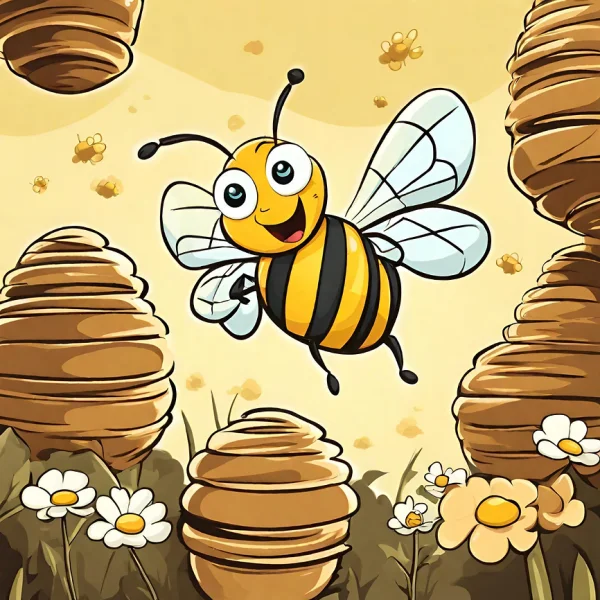
About the Story
What if you had magic powers and could shrink, grow wings, have six legs instead of two, three eyes instead of two, antennae instead of ears, become fuzzy all over, collect nectar from flowers, and make something very sweet that bears and humans love to eat? What did you turn into? Yes, you are now a bee and your new home is a hive! Let’s imagine that this really did happen, and you wrote about it in your journal after you turned back into a human.
Here’s what your story might say:
I am now officially a bee. I have two pairs of wings and six legs, so I belong to the insect world. I’m very busy supporting my bee family of about 70,000 members. I turned into a worker bee, and my job is to gather nectar and pollen from the fields. Hail to the queen bee in our hive who’s busy laying between 1,200 - 2,000 eggs a day! She’s bigger than all the other bees, and is our fearless leader. I have these cool little pouches on the back of my legs in which I put the pollen I collect. My tongue is like a tube and it comes in handy as I suck nectar out of flowers. I also have an extra stomach for storing and transporting nectar to my hive where other bees help make honey and store it in hexagon shaped cells.
One of my favorite jobs is when I get to be a nurse bee and take care of the Queen’s hatched eggs, which are white worm-like larvae in the shape of peanuts. Sometimes I feed Her Royal Highness a special food called royal jelly that only she gets to eat.
Before going out to the field to collect nectar I have to go to bee school. A bunch of us worker bees hang around outside the hive, facing it, and flying backwards to see what it looks like from a few feet away so we could remember how to get back home after collecting nectar. After graduating from bee school, we begin scouting for flowers.
When I find lots of sumptuous flowers, I fly back to the hive to share the fragrances of the field with other foragers (those who gather food). To convince my family of bees, I do a bee dance by making a figure eight that lets them know where the flowers are in relation to the sun. I wiggle and wiggle until they start to follow me.
We keep safe and protected in the hive thanks to the guard bees. We do have enemies, like skunks and bears. The guard bees are the strongest among us and they examine all those who seek to enter our home, reaching out with their antennae to smell-check. Predators (enemies) are chased away and stung. Maybe you’ve been stung by a bee? I’m sure it hurt but that bee was just protecting itself.
Journal Reflections after turning back into a human: Living among the bees has taught me a lot about cooperation. None of us humans could survive on our own. It made me realize how lucky I am to be a part of a family at home, and a class with a teacher at school. I’m also a part of a community where there are people who keep me safe, like the police and fire departments. Doctors take care of my health. Farmers produce food that grocery stores sell to my family. Gas stations provide gas so we can travel. Because we depend so much on each other we’re really not that different from bees!