About the Story
Story: A teacher decides to invite her class to participate in an activity. She blindfolds her students and leads them into a building that has two rooms. They enter one room - people are arguing, shouting, even screaming, but they don’t know why because they can’t see. The strange thing is that something smells really delicious making them very hungry - but they can’t wait to get away. They leave and the teacher guides them to the other room. People in this room are chatting comfortably with one another - they seem very happy. Students hear slurping sounds and smell something delicious, just like in the other room. What’s going on? Any guesses?
No one figures out what’s going on, so the teacher has them take off their blindfolds and they enter room #1. It’s a dining room with a circular table that surrounds a very large pot with delicious, warm noodles. People are seated around the table complaining and arguing, trying to eat with very long chopsticks as utensils. Unfortunately, the chopsticks are really long and the diners can’t reach their mouths. They end up hitting one another as they try to maneuver these utensils. They’re really hungry but can’t eat this delicious food no matter how hard they try to get it in their mouths. If you had a 3 foot long chopstick could you reach your mouth?
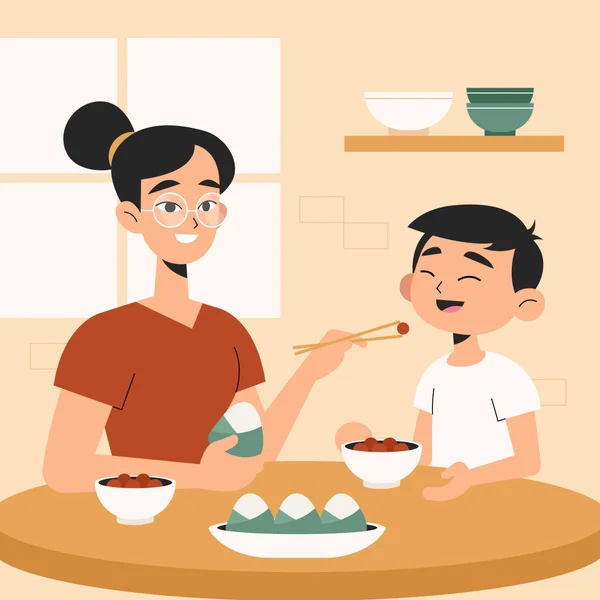
The students can’t wait to get away from that disaster, so they quickly exit and move on to room #2 which also is a dining room with a circular table that surrounds a very large pot with delicious, warm noodles. Here everyone is content and fully satisfied as they reach with their long chopsticks and feed each other across the table! These people had found a solution to the problem through cooperation and serving one another.
Back in class, the students discuss their observations. Everyone raises their hand when the teacher asks them if they’d prefer to be in room #2, even though it meant that they’d have to serve someone else. No one wanted to be in the group in room #1. “It’s obvious,” one student says, “When we’re just thinking about ourselves, like those in room #1, we miss out on opportunities.” The students were able to see first hand that when people are willing to give and share like those in room #2, it works out better for everyone.
No one figures out what’s going on, so the teacher has them take off their blindfolds and they enter room #1. It’s a dining room with a circular table that surrounds a very large pot with delicious, warm noodles. People are seated around the table complaining and arguing, trying to eat with very long chopsticks as utensils. Unfortunately, the chopsticks are really long and the diners can’t reach their mouths. They end up hitting one another as they try to maneuver these utensils. They’re really hungry but can’t eat this delicious food no matter how hard they try to get it in their mouths. If you had a 3 foot long chopstick could you reach your mouth?
The students can’t wait to get away from that disaster, so they quickly exit and move on to room #2 which also is a dining room with a circular table that surrounds a very large pot with delicious, warm noodles. Here everyone is content and fully satisfied as they reach with their long chopsticks and feed each other across the table! These people had found a solution to the problem through cooperation and serving one another.
Back in class, the students discuss their observations. Everyone raises their hand when the teacher asks them if they’d prefer to be in room #2, even though it meant that they’d have to serve someone else. No one wanted to be in the group in room #1. “It’s obvious,” one student says, “When we’re just thinking about ourselves, like those in room #1, we miss out on opportunities.” The students were able to see first hand that when people are willing to give and share like those in room #2, it works out better for everyone.